Routine Charts for Kids: How Predictability Supports Healthy Development
Introduction: The Hidden Power of "What Comes Next"
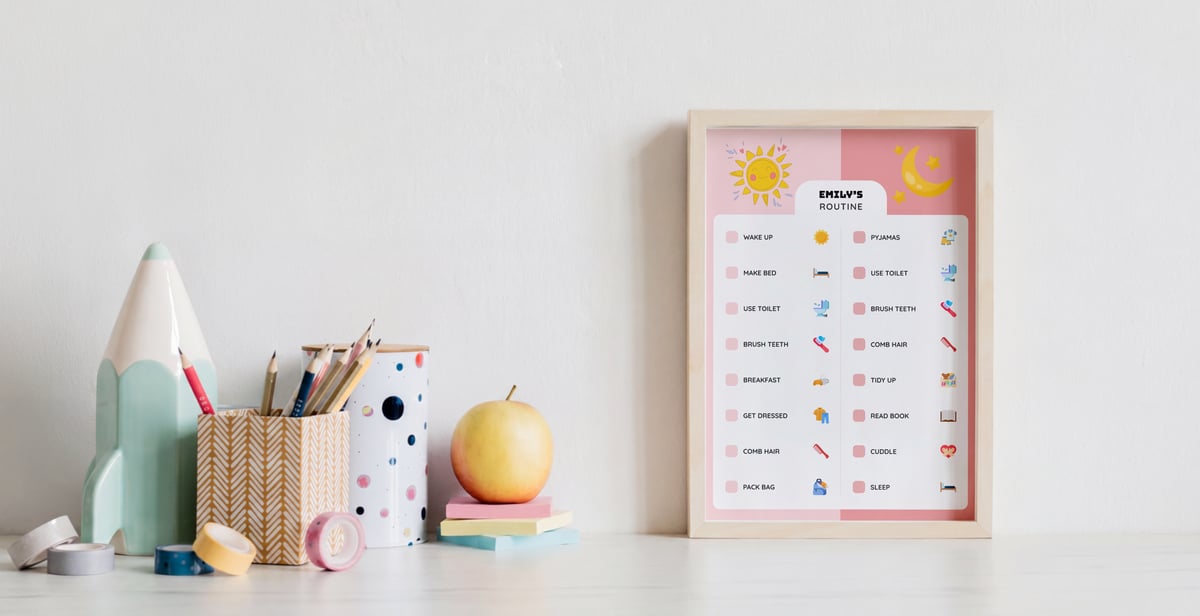
A colourful chart pinned to the fridge showing wake up → brush teeth → get dressed → breakfast → school might look like a simple household tool. But for a young child, it can be much more than a checklist. It is a window into the future — a miniature map of the day that makes what comes next easier to understand.
Young children benefit from consistency and predictability. According to the CDC, routines can help children know what to expect and create a greater sense of structure and security.
A visual routine chart makes that predictability visible and tangible. Instead of relying on repeated verbal reminders, children can see the sequence of their day for themselves and gradually take a more active role in following it.
The Developing Brain Benefits From Structure
The mental skills that help us plan, focus attention, remember instructions, switch between tasks, and control impulses are known as executive functions. These abilities begin developing early in childhood and continue maturing through adolescence.
Young children are therefore still learning how to organise themselves. They often benefit from external support such as visual prompts, predictable sequences, and caring adults who provide consistent structure.
The Harvard Center on the Developing Child describes executive function as a group of skills that helps us plan, focus attention, switch gears, and manage multiple tasks.
Harvard's Ready4Routines project also explores how everyday family routines can increase predictability in young children's lives while creating opportunities to practise executive-function skills.
When a child follows the same sequence regularly, they gradually become more familiar with what comes next. A routine chart can support this process by reducing how much information a child has to remember at once.
Instead of hearing "Go upstairs, get dressed, brush your teeth, find your school bag and put your shoes on," the child can simply look at the chart and take one step at a time.
Routine and Emotional Regulation
Uncertainty can be difficult for young children. Questions such as "What happens after lunch?" or "When are we leaving?" may feel much more significant when a child's understanding of time and daily schedules is still developing.
Predictable routines can reduce some of this uncertainty.
The CDC notes that consistent routines help children know what to expect. Having a familiar sequence can be particularly useful during transitions — such as getting ready for school, leaving the playground, preparing for bed, or moving from one activity to another.
A visual routine chart does not prevent every meltdown, nor should parents expect it to. Children still get tired, frustrated, hungry, excited, or overwhelmed.
What a routine can do is remove one source of friction: not knowing what comes next.
Over time, familiar routines may also give children more opportunities to practise moving from one activity to another, coping with small changes, and completing everyday tasks with less adult prompting.
Building Executive Function, One Morning at a Time
Executive function includes skills such as working memory, flexible thinking, attention, and self-control. These skills play an important role in learning and everyday life.
Routine charts can provide a simple, low-pressure environment in which children practise some of these abilities.
Each time a child checks what comes next, completes a step, and moves on, they may be practising skills such as:
- Working memory — remembering what they are doing and what comes next
- Inhibitory control — waiting before moving straight to a preferred activity
- Task initiation — beginning a familiar task with less prompting
- Cognitive flexibility — adapting when the normal routine needs to change
- Planning — understanding that several small steps lead towards a larger goal
For example, "getting ready for school" is an abstract instruction for a four-year-old.
But:
get dressed → eat breakfast → brush teeth → pack bag → put on shoes
turns it into a sequence of manageable actions.
With repetition, children may need fewer reminders as the sequence becomes increasingly familiar.
Fostering Independence and Confidence
One of the most practical benefits of a routine chart is that it transfers some responsibility from the adult to the child.
Instead of a parent repeatedly saying:
"Brush your teeth."
"Now get dressed."
"Where are your shoes?"
the chart becomes the reminder.
A child can look at it, identify the next step, complete it, and mark it as finished.
These small experiences of doing things independently can help children develop confidence in managing everyday tasks.
It can also make routines feel more collaborative. Rather than constantly being directed by an adult, the child begins to participate in managing their own morning or bedtime.
Where possible, involve your child in creating the chart. Let them choose pictures, decide how completed tasks will be marked, or help arrange the steps in order.
A routine is more likely to feel like their tool rather than another set of instructions imposed by an adult.
Sleep Routines: A Special Case
Bedtime is one area where consistent routines have been particularly well studied.
A large study of young children found that having a consistent bedtime routine was associated with earlier bedtimes, shorter time needed to fall asleep, fewer night wakings, and longer sleep duration.
You can read the study in PubMed.
A bedtime routine does not have to be complicated. In fact, a short and predictable sequence is often easier for young children to follow:
tidy toys → bath → pyjamas → brush teeth → story → bed
Repeating similar calming activities each evening creates familiar cues that bedtime is approaching.
For children who struggle with transitions at night, a visual bedtime chart can make the sequence clearer and reduce the need for repeated instructions.
Routine Charts for ADHD, Autism, and Different Temperaments
Not every child responds to routines in the same way.
Some children naturally enjoy knowing exactly what will happen next. Others prefer novelty and may resist schedules that feel too restrictive.
Visual schedules have also been studied specifically in children with developmental differences.
A review of visual activity schedules found evidence supporting their use with autistic children, particularly when combined with appropriate instruction and support. You can read the review in PubMed.
Research has also examined visual activity schedules for children with ADHD. A systematic review found promising evidence for uses including supporting transitions, increasing on-task behaviour, and reducing some problem behaviours, although the evidence base remains relatively small. The review is available through PubMed.
This does not mean a routine chart is a treatment for ADHD, autism, or anxiety.
Instead, visual schedules can be one practical tool for making expectations and transitions clearer for children who benefit from additional predictability.
For children who dislike rigid routines, it can help to build choices into the structure:
"After breakfast, choose one: read, draw, or play until it is time to leave."
Predictability and autonomy do not have to be opposites.
What Should Be Included in a Kids' Routine Chart?
The best routine charts focus on a specific part of the day rather than trying to organise everything at once.
Example Morning Routine
A simple morning routine might include:
- Wake up
- Use the toilet
- Get dressed
- Eat breakfast
- Brush teeth
- Pack school bag
- Put on shoes
Example Bedtime Routine
A bedtime chart could include:
- Tidy toys
- Take a bath or shower
- Put on pyjamas
- Brush teeth
- Choose a book
- Read together
- Lights out
The exact routine is less important than choosing steps that make sense for your own family and keeping the sequence reasonably consistent.
Practical Tips for Effective Routine Charts
A routine chart should make life simpler, not become another source of pressure.
Here are a few principles that work well for many families:
- Use pictures for younger children — children who cannot yet read can recognise an illustration of a toothbrush, T-shirt, or school bag.
- Keep it manageable — start with a small number of clear steps rather than displaying an entire day at once.
- Put it where the routine happens — a morning chart might belong in the bedroom or kitchen, while a bedtime chart works best near the child's bedroom.
- Let children mark completed steps — checkboxes, magnets, sliders, or moveable markers can make the routine more interactive.
- Use positive instructions — "put toys in the box" is clearer than "don't leave toys everywhere."
- Be consistent without becoming rigid — routines should support family life, not control it. Some days will be different.
- Give choices where possible — children can follow a predictable structure while still having some control over how they move through it.
- Update the chart as your child grows — a seven-year-old will need a different routine from a three-year-old.
Most importantly, the chart should gradually make adults less necessary as reminders, not turn parents into supervisors checking whether every box was completed perfectly.
The Long View: Learning to Manage Everyday Life
Routine charts are not magic, and using one does not guarantee that a child will become more organised, emotionally regulated, or independent.
Their value is much simpler.
They turn an abstract expectation into something a young child can see and understand.
"Get ready for school" becomes five small steps.
"Get ready for bed" becomes a familiar sequence.
And over time, children have repeated opportunities to practise remembering, starting, completing, and transitioning between everyday tasks.
Those are useful skills long after the chart itself is no longer needed.
A simple picture of a toothbrush or school bag may not look like much, but for a child learning how to navigate their day, it can be a surprisingly powerful tool.
Frequently Asked Questions
What age can children start using a routine chart?
Simple picture-based routine charts can be introduced during the toddler and preschool years. Younger children generally need more adult guidance, while older children can gradually take greater responsibility for following the chart independently.
How many tasks should be on a routine chart?
There is no universal ideal number. Start with enough steps to make the routine clear without making the chart overwhelming. For younger children, separating the day into smaller routines — such as morning and bedtime — is usually easier than creating one large all-day schedule.
Do routine charts help children with ADHD or autism?
Visual schedules have been studied as a support for children with autism and ADHD, with evidence suggesting they can help some children understand expectations, complete activities, and manage transitions. They should be viewed as a practical support tool rather than a treatment for either condition.
Should children get rewards for completing their routine?
They do not necessarily need to. For many everyday routines, the goal is to make the sequence predictable and gradually build independence. Praise, encouragement, or simply allowing the child to mark a task as complete may be enough.
Get Started Today
If you would like to introduce a routine chart for your child, Miniema offers editable routine chart templates for kids that you can adapt to your own family's day.
Choose a design your child enjoys, customise the individual steps, and print it at home.
Start with one routine — morning, bedtime, getting ready for school, or another part of the day that regularly causes friction — and keep it simple.
Sources & Further Reading
- CDC — Tips for Relying on Routines and Rules
- Harvard Center on the Developing Child — A Guide to Executive Function
- Harvard Center on the Developing Child — Ready4Routines
- Mindell et al. — Bedtime Routines for Young Children
- Knight et al. — Visual Activity Schedules and Autism
- Thomas & Karuppali — Visual Activity Schedules for Children With ADHD
Ready to create a routine chart?
Browse our printable routine templates for kids.